

Choice Made Simple!
Too many options?Click below to purchase an online gift card that can be used at participating retailers in Village Green Shopping Centre and continue your shopping IN CENTRE!Purchase HereHome
The Minimum Description Length Principle by Peter D. Grunwald, Paperback | Indigo Chapters
Coles
Loading Inventory...
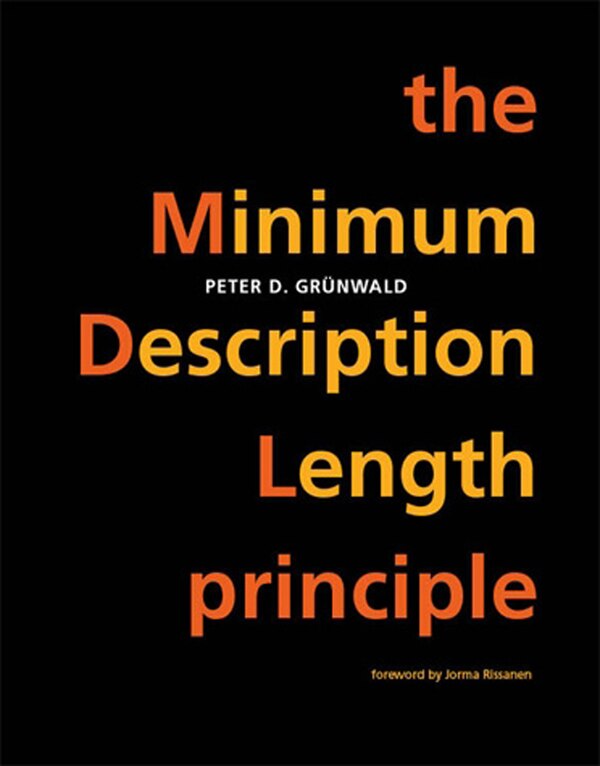
The Minimum Description Length Principle by Peter D. Grunwald, Paperback | Indigo Chapters in Vernon, BC
By Peter D. Grunwald
Current price: $105.00
Coles
The Minimum Description Length Principle by Peter D. Grunwald, Paperback | Indigo Chapters in Vernon, BC
By Peter D. Grunwald
Current price: $105.00
Loading Inventory...
Size: 1 x 9.188 x 0.8125
*Product information may vary - to confirm product availability, pricing, shipping and return information please contact Coles
A comprehensive introduction and reference guide to the minimum description length (MDL) Principle that is accessible to researchers dealing with inductive reference in diverse areas including statistics, pattern classification, machine learning, data mining, biology, econometrics, and experimental psychology, as well as philosophers interested in the foundations of statistics. The minimum description length (MDL) principle is a powerful method of inductive inference, the basis of statistical modeling, pattern recognition, and machine learning. It holds that the best explanation, given a limited set of observed data, is the one that permits the greatest compression of the data. MDL methods are particularly well-suited for dealing with model selection, prediction, and estimation problems in situations where the models under consideration can be arbitrarily complex, and overfitting the data is a serious concern. This extensive, step-by-step introduction to the MDL Principle provides a comprehensive reference (with an emphasis on conceptual issues) that is accessible to graduate students and researchers in statistics, pattern classification, machine learning, and data mining, to philosophers interested in the foundations of statistics, and to researchers in other applied sciences that involve model selection, including biology, econometrics, and experimental psychology. Part I provides a basic introduction to MDL and an overview of the concepts in statistics and information theory needed to understand MDL. Part II treats universal coding, the information-theoretic notion on which MDL is built, and part III gives a formal treatment of MDL theory as a theory of inductive inference based on universal coding. Part IV provides a comprehensive overview of the statistical theory of exponential families with an emphasis on their information-theoretic properties. The text includes a number of summaries, paragraphs offering the reader a fast track through the material, and boxes highlighting the most important concepts. | The Minimum Description Length Principle by Peter D. Grunwald, Paperback | Indigo Chapters
A comprehensive introduction and reference guide to the minimum description length (MDL) Principle that is accessible to researchers dealing with inductive reference in diverse areas including statistics, pattern classification, machine learning, data mining, biology, econometrics, and experimental psychology, as well as philosophers interested in the foundations of statistics. The minimum description length (MDL) principle is a powerful method of inductive inference, the basis of statistical modeling, pattern recognition, and machine learning. It holds that the best explanation, given a limited set of observed data, is the one that permits the greatest compression of the data. MDL methods are particularly well-suited for dealing with model selection, prediction, and estimation problems in situations where the models under consideration can be arbitrarily complex, and overfitting the data is a serious concern. This extensive, step-by-step introduction to the MDL Principle provides a comprehensive reference (with an emphasis on conceptual issues) that is accessible to graduate students and researchers in statistics, pattern classification, machine learning, and data mining, to philosophers interested in the foundations of statistics, and to researchers in other applied sciences that involve model selection, including biology, econometrics, and experimental psychology. Part I provides a basic introduction to MDL and an overview of the concepts in statistics and information theory needed to understand MDL. Part II treats universal coding, the information-theoretic notion on which MDL is built, and part III gives a formal treatment of MDL theory as a theory of inductive inference based on universal coding. Part IV provides a comprehensive overview of the statistical theory of exponential families with an emphasis on their information-theoretic properties. The text includes a number of summaries, paragraphs offering the reader a fast track through the material, and boxes highlighting the most important concepts. | The Minimum Description Length Principle by Peter D. Grunwald, Paperback | Indigo Chapters
You May Also Like









More About Coles at Village Green Shopping Centre
Find everything in-store including new, used and children’s books, music, movies, games and toys. Visit Coles today to find the perfect gift, or a novel for yourself. COVID-19 UPDATE: Open | Regular Centre Hours
Store Info
Find Coles at Village Green Shopping Centre in Vernon, BC
Visit Coles at Village Green Shopping Centre in Vernon, BC