

Choice Made Simple!
Too many options?Click below to purchase an online gift card that can be used at participating retailers in Village Green Shopping Centre and continue your shopping IN CENTRE!Purchase HereHome
Perspectives on Thinking Learning and Cognitive Styles by Robert J. Sternberg, Paperback | Indigo Chapters
Coles
Loading Inventory...
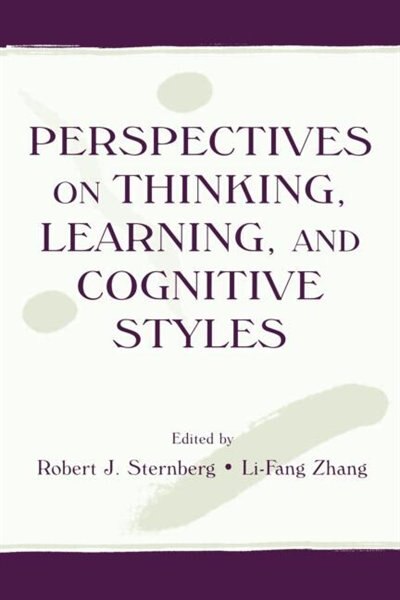
Perspectives on Thinking Learning and Cognitive Styles by Robert J. Sternberg, Paperback | Indigo Chapters in Vernon, BC
By Robert J. Sternberg
Current price: $130.50
Coles
Perspectives on Thinking Learning and Cognitive Styles by Robert J. Sternberg, Paperback | Indigo Chapters in Vernon, BC
By Robert J. Sternberg
Current price: $130.50
Loading Inventory...
Size: 0.8 x 9 x 1.17
*Product information may vary - to confirm product availability, pricing, shipping and return information please contact Coles
This volume presents the most comprehensive, balanced, and up-to-date coverage of theory and research on cognitive, thinking, and learning styles, in a way that:* represents diverse theoretical perspectives;* includes solid empirical evidence testing the validity of these perspectives; and* shows the application of these perspectives to school situations, as well as situations involving other kinds of organizations. International representation is emphasized, with chapters from almost every major leader in the field of styles. Each chapter author has contributed serious theory and/or published empirical data-work that is primarily commercial or that implements the theories of others. The book's central premise is that cognitive, learning, and thinking styles are not abilities but rather preferences in the use of abilities. Traditionally, many psychologists and educators have believed that people's successes and failures are attributable mainly to individual differences in abilities. However, for the past few decades research on the roles of thinking, learning, and cognitive styles in performance within both academic and nonacademic settings has indicated that they account for individual differences in performance that go well beyond abilities. New theories better differentiate styles from abilities and make more contact with other psychological literatures; recent research, in many cases, is more careful and conclusive than are some of the older studies. Cognitive, learning, and thinking styles are of interest to educators because they predict academic performance in ways that go beyond abilities, and because taking styles into account can help teachers to improve both instruction and assessment and to show sensitivity to cultural and individual diversity among learners. They are also of interest in business, where instruments to assess styles are valuable in selecting and placing personnel. The state-of-the-art research and theory in this volume will be of particular interest to scholars and graduate students in cognitive and educational psychology, managers, and others concerned with intellectual styles as applied in educational, industrial, and corporate settings. | Perspectives on Thinking Learning and Cognitive Styles by Robert J. Sternberg, Paperback | Indigo Chapters
This volume presents the most comprehensive, balanced, and up-to-date coverage of theory and research on cognitive, thinking, and learning styles, in a way that:* represents diverse theoretical perspectives;* includes solid empirical evidence testing the validity of these perspectives; and* shows the application of these perspectives to school situations, as well as situations involving other kinds of organizations. International representation is emphasized, with chapters from almost every major leader in the field of styles. Each chapter author has contributed serious theory and/or published empirical data-work that is primarily commercial or that implements the theories of others. The book's central premise is that cognitive, learning, and thinking styles are not abilities but rather preferences in the use of abilities. Traditionally, many psychologists and educators have believed that people's successes and failures are attributable mainly to individual differences in abilities. However, for the past few decades research on the roles of thinking, learning, and cognitive styles in performance within both academic and nonacademic settings has indicated that they account for individual differences in performance that go well beyond abilities. New theories better differentiate styles from abilities and make more contact with other psychological literatures; recent research, in many cases, is more careful and conclusive than are some of the older studies. Cognitive, learning, and thinking styles are of interest to educators because they predict academic performance in ways that go beyond abilities, and because taking styles into account can help teachers to improve both instruction and assessment and to show sensitivity to cultural and individual diversity among learners. They are also of interest in business, where instruments to assess styles are valuable in selecting and placing personnel. The state-of-the-art research and theory in this volume will be of particular interest to scholars and graduate students in cognitive and educational psychology, managers, and others concerned with intellectual styles as applied in educational, industrial, and corporate settings. | Perspectives on Thinking Learning and Cognitive Styles by Robert J. Sternberg, Paperback | Indigo Chapters
You May Also Like









More About Coles at Village Green Shopping Centre
Find everything in-store including new, used and children’s books, music, movies, games and toys. Visit Coles today to find the perfect gift, or a novel for yourself. COVID-19 UPDATE: Open | Regular Centre Hours
Store Info
Find Coles at Village Green Shopping Centre in Vernon, BC
Visit Coles at Village Green Shopping Centre in Vernon, BC